
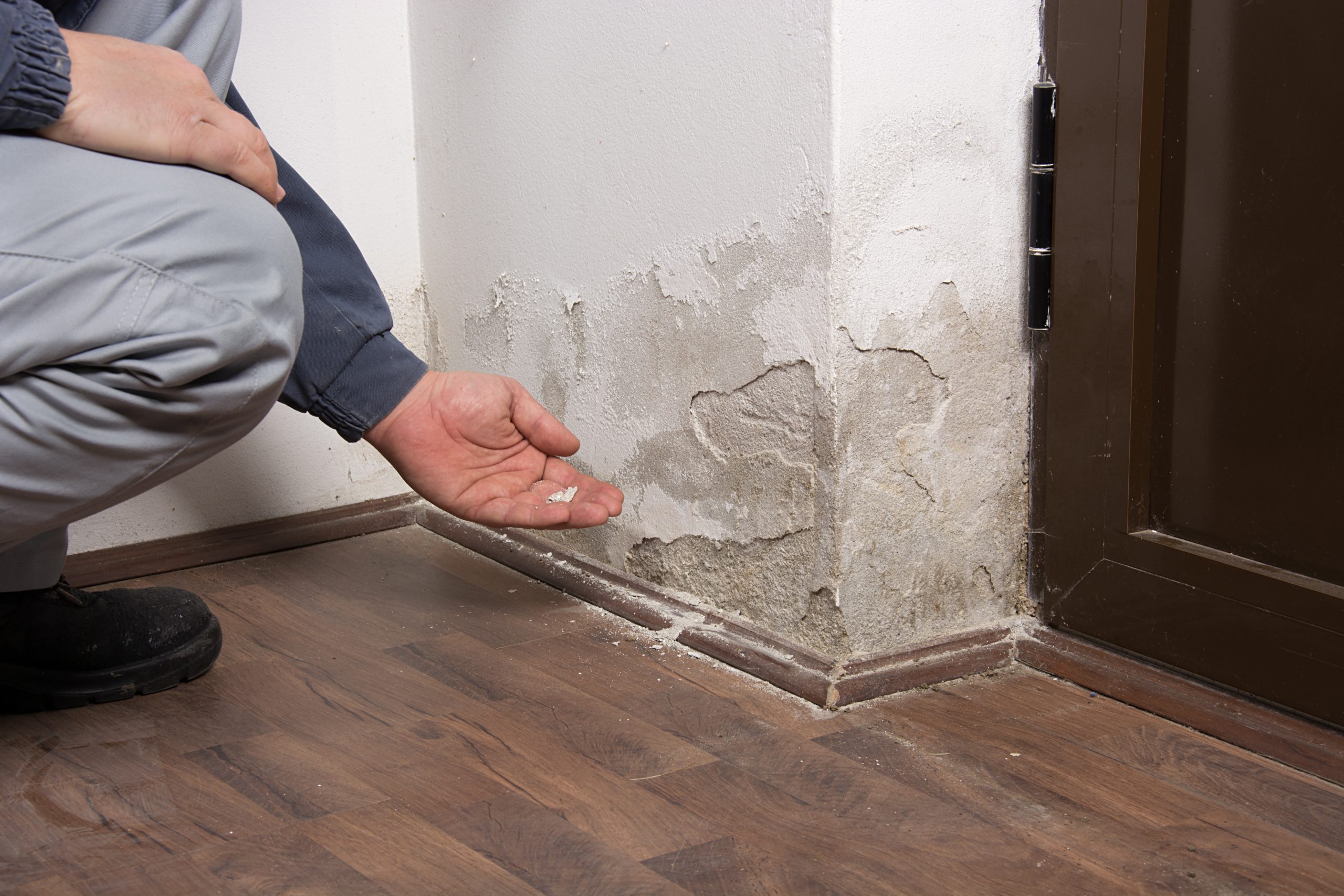
What the Higher Regional Court of Cologne decided regarding the sponge exclusion clause in residential building insurance
After a burst pipe, building insurance does not automatically cover damage caused by dry rot. The Higher Regional Court of Cologne (OLG Köln) confirmed the validity of the dry rot exclusion clause in its ruling of February 10, 2026 (Case No. 9 U 19/23). However, damage caused solely by water without a proven connection to dry rot remains covered. Rogert & Ulbrich will review your claim to determine which damages your insurer is obligated to cover.
The case: Tap water from the shower and a white pore sponge
A homeowner had a bathroom with a shower installed on the upper floor of her timber-framed house. During subsequent repairs, water damage was discovered in the shower area. The floor structure was heavily infested with white pore dry rot, a wood-destroying fungus.
The homeowner demanded approximately €66,000 from her building insurer. The insurer cited the exclusion clause in the policy for damage caused by dry rot. Only just under €5,000 was reimbursed for pure water damage not attributable to dry rot.
The legal dispute went all the way to the Federal Court of Justice. By decision of November 13, 2024 (Case No. IV ZR 212/23), the Federal Court of Justice referred the case back to the Higher Regional Court of Cologne. The Higher Regional Court was to clarify whether dry rot is such a typical consequence of water damage that the exclusion jeopardizes the purpose of the insurance policy.
Is your building insurance company refusing payment due to dry rot? Have the reasoning reviewed in detail.
The decision: Sponge exclusion is effective
The Higher Regional Court of Cologne, after obtaining an expert opinion, declared the sponge exclusion clause valid. As a clause restricting performance, it is subject to review under the rules governing standard business terms and conditions. It would only be invalid under Section 307 Paragraph 2 No. 2 of the German Civil Code (BGB) if it so severely restricted essential rights that the purpose of the contract was jeopardized.
According to the court, this would only be the case if mold damage were a regular, or at least very frequent, inevitable, and characteristic consequence of water leakage, affecting virtually the entire building. The owner failed to provide this proof. The expert concluded that mold rarely forms as a result of water damage.
The court also clarified that the term "fungus" in the policy terms is to be interpreted broadly and encompasses all wood-destroying fungi, including the white pore fungus. The court rejected claims based on good faith and a breach of the insurer's duty to advise. Since the contract had been brokered through an insurance agent, the insurer had no duty to advise under Section 6 Paragraph 5 of the German Insurance Contract Act (VVG) (Section 6 Paragraph 6 VVG).
The exclusion for mold damage in your building insurance policy is likely to be valid. Therefore, it is all the more important to clearly assign each individual damage claim.
What remains insured despite the exclusion of sponges
The exclusion does not automatically cover all consequences of water damage. Damage caused by moisture remains reimbursable, provided a causal link to the sponge cannot be proven. In the case at hand, this amounted to just under €5,000 for pure moisture damage.
Anyone invoking an exclusion of coverage must generally prove that its conditions are met. This burden usually rests with the insurer. They must therefore demonstrate which damages were actually caused by dry rot. A general reference to existing dry rot infestation is insufficient to reject all claims.
Typically, the following damages can also be covered by insurance in the case of fungal infestation:
- Soaked components: Screed, insulation or wall surfaces that have been damaged by tap water, without being attacked by the fungus.
- Drying costs: Costs for the technical drying of rooms and building components, insofar as they are attributable to water damage.
- Leak detection and pipe burst: Costs for locating and eliminating the water leak, depending on the conditions.
- Consequential damage to surfaces: Floor coverings, tiles or paintwork that have been damaged by moisture.
- Extra costs: Clean-up, demolition and removal costs, insofar as they relate to the insured part of the damage and are covered by the contract.
Whether individual items are insured depends on your policy terms. You can find more information on our website. Lawyer specializing in building insurance.
Is your insurer rejecting the entire claim due to mold? Demand a transparent breakdown of the damage items.
Typical mistakes in the settlement of sponge damage claims
In cases of water damage caused by mold, details in the documentation often determine the amount of compensation. Common errors include:
- Premature renovation: If components are removed before the damage is documented, it is almost impossible to prove later which damage is due to moisture and which is due to mold.
- Missing photos: Complete photographic documentation of all affected areas is essential for demarcation.
- No independent assessment: Those who rely solely on the insurer's assessment have little recourse to verify its evaluation.
- Flat-rate cost estimates: Remediation proposals should be broken down by cause of damage so that insured and excluded items can be separated.
- Obligations overlooked: Report the damage immediately and take measures to mitigate the loss. Failure to do so may jeopardize your insurance coverage.
Information on your obligations in the event of damage can also be found on our page about Contract interpretation and breaches of duty.
Do not allow anything to be demolished before the damage is fully documented. What has been disposed of cannot be proven.
Here's how to proceed in case of water damage with mold infestation
Report the water damage to your building insurer immediately. Document all affected areas with photos and, if possible, videos. Keep any removed building components until the insurer or an assessor has inspected them, or arrange for their disposal beforehand.
Have the damage assessed by an independent expert. It is important to itemize which components need to be repaired or replaced and why. An expert report, photos, and a transparent breakdown of the repair costs are crucial for distinguishing between covered and excluded damages.
Also, check how your contract came about. If it was brokered through an agent, it may be necessary to examine whether they correctly advised you about exclusions and possible additional clauses. You can find more information on our page about Claims denied by insurers.
Has your building insurance reduced or rejected your claim? Have each claim item reviewed individually.
Rogert & Ulbrich – Your lawyers in insurance law
Rogert & Ulbrich represents property owners nationwide in dealings with residential building and contents insurers. The firm is managed by Dr. Marco Rogert and Tobias Ulbrich and has already handled over 40,000 cases. Insurance law We are familiar with the objections raised by insurers in cases of water damage and mold damage.
We review your insurance policy, the reason for the rejection, and the individual items of damage. We pursue your insured claims against the insurer out of court. If necessary, we will also represent you in court.
Your building insurance company is refusing or reducing payment because